THOUSANDS OF FREE BLOGGER TEMPLATES
Showing posts with label laxman ganga. Show all posts

Friday, June 18, 2010

Rishikesh...Bliss On The Holy Banks Of Ganga.....

                         Rishikesh - Gateway to the Himalayas....

Rishikesh represents the Gateway to the Himalayas in the Tehri-Garhwal region of Uttar Pradesh. It abounds in natural splendour. The spectacle of the Ganga rushing through the Himalayan foothills is an awesome sight. Several temples dot the banks of the Ganga at Rishikesh.

Rishikesh is located at a height of about 1360 feet above sea level. It is believed that several yogis and sages lived and practised penance here. Rishikesh represents the site where Lord Vishnu vanquished the demon Madhu. हृषीकेश is a name of Lord Vishnu that means 'lord of the senses'. Rishikesh is a holy city for Hindus located in the foothills of the Himalaya in northern India. The place got its name after Lord Vishnu who appeared to 'Raibhya Rishi', as a result of his tapasya (austerities), as Lord Hrishikesh . In Skanda Purana, this area is known as 'Kubjamrak' as Lord Vishnu appeared, under a mango tree


Rishikesh derived from the word Hrishikesh, is another name of Lord Vishnu, who is said to have destroyed the demon Madhu here. Legend also has it that Lord Rama, on the advice of the sage Vasishtha, sought penance here after having killed Ravana. Thus in Sanskrit, Rishikesh means 'he who has conquered his senses'.


Aarti On The Banks Of Ganga


Historically, Hrishikesh, has been a part of the legendary 'Kedarkhand' (the present day Garhwal), the abode of Shiva. Legends state that Lord Rama did penance here for killing Ravana, the demon king of Lanka; and Lakshmana, his younger brother, crossed the river Ganga, at a point, where the present 'Lakshman Jhula' bridge stands today, using a jute rope bridge. The 'Kedar Khand' of Skanda Purana, also mentions the existence of Indrakund at this very point.


Statue Of Lord Shiva


The sacred river Ganga flows through Rishikesh. In fact, it is here that the river leaves the Shivalik mountains in the Himalayas and flows out into the plains of northern India. Several temples, ancient as well as new, can be found along the banks of the Ganges in Rishikesh. The city attracts thousands of pilgrims and tourists each year, from within India, as well as from other countries.


.

Laxman Jhoola


Tryambakeshwar Temple


Rishikesh, sometimes nicknamed "the world capital of Yoga", has numerous yoga centres that also attract tourists. It is believed that meditation in Rishikesh brings one closer to attainment of moksha, as does a dip in the holy river that flows through it. It is also becoming a popular spot for white water rafting enthusiasts, both from India and abroad, as it offers medium to rough rapids in the course of river Ganges.


Ganga sen from Laxman Jhoola


The Other Side Of Laxman Jhoola


Rishikesh became famous when Beatles visited now defunct Mahesh Yogi Ashram.They composed some of their songs on the bank of the river.


Lachman Jhoola....The main attraction of Rishikesh. It is a suspended bridge, built in 1939. Surajmal Nagarmal, the famous merchants of Calcutta paid the cost of the bridge.Just across the bridge, on the other side two temples will certainly attract attentions by their sheer heights! One is 13 storied temple and the other one is 12 storied temple… Visit them if you have ample time. Deities are placed all over the temples from ground 0 to upwards…


The Lachman Jhoola and 13+12 storied temples on the other bank

The name Rishikesh is loosely applied to an association of five distinct sections encompassing not only the town but also hamlets and settlements on both sides of the river Ganges.North of Rishikesh; the temple section of Lakshman Jhula, a little further north; and the assorted Ashrams around Swarg Ashram on the east bank. One can reach the famous Neelakanta Maha Deva Temple from here. The Ganga Arati performed at dusk at the Triveni Ghat is popular with visitors.

On The Way To Neelkanth Mahadev Temple..


The temple is very old and Shrabanimela, every year in mid July , occurs here.


Shri Neelkanth Mahadev Temple


About a Km from entrance of Ram Jhoola( Also known as Shivananda Jhoola) is Geeta Bhavan . The epics, Ramayana and Mahabharata are sculpted on its wall. It is run by famous Geeta Press of Gorakhpur and was established in 1950. Ram Jhoola is longer and wider than its younger brother. It is too a hanging bridge.You can feed the fishes in the river from here.


The Ram Jhoola Or The Shivanand Jhoola


On Triveni Ghat In the evening The Sandhya Aaarti just like Haridwar is performed here too. But it is not as gorgeous as Haridwar.But the scenic beauty of this place gave it another dimension.


Sandhya Aarti On Triveni Ghat


Rishikunda and Raghunathji Mandir are adjacent to it.About ½ km away is Bharat Mandir built by Adiguru Shankarcharya. The main deity is Lord Vishnu, carved out one piece Shaligram.It was destroyed by Taimur in 1398 and it was rebuilt afterwards.One thing caught my mind, in Rishikesh all the four brothers are worshipped in different temples. Raghunathji and Bharat mandir in Triveni Ghat area, Laxman mandir near Lachman Jhoola and Shatrughna mandir near Muni ki reti area.


Rishi Kunda and Raghunathji Temple -Triveni Ghat


The Bharat Mandir


The Shiva who wore shoes! It has been mentioned in the small museum adjacent to the temple .


The Ferry Ghat From Ram Jhoola


From tourist point of views Rishikesh can be divided into 3 parts.

1. Laxman Jhoola and adjoining mandirs.
2. Ram Jhoola and adjoining ashrams and Yoga study centers

3. Triveni Ghat and adjoining mandirs.


Sun, The Boat and The River


Giant Statue Of Lord Shiva


Famous Chotiwala Restaurant


Giant Statue Of Lord Shiva


|| ॐ नमः शिवाय ||

Landscape Of Rishikesh

Haridwar....The Gateway To The Four Pilgrimages.....

Haridwar....The Abode Of Lord Shiva....

Haridwar,a holy place of the Saints and Sagas,where the Holy Ganges is revered,is located n the foothills of the Himalayas, represents the point where the Ganga reaches the plains. Haridwar is an ancient pilgrimage site, held in reverence for centuries. The Chinese pilgrim Hyuen Tsang who visited India in the first millennium CE, describes Haridwar as Mayura, on the eastern banks of the Ganges. Several temples and ashrams dot this town and a visit to Haridwar is like stepping into a totally different world.


A sage in Haridwar..


Legend has it that Bhagiratha, brought the Ganges into the earth, and into this point where his ancestors were burnt to ashes by the curse of the sage Kapila. Kapilastaan, a spot in Haridwar is pointed to as Kapila's hermitage. Haridwar was once known as Gangadwara. Haridwar (and Rishikesh) represents the gateway to the Himalayan pilgrimage shrines of Gangotri,Yamunotri,Badrina
th ,Kedarnath. The pilgrimage to the Himalayan shrines begins only when the sun reaches the zodiac sign of Aries. Haridwar is also the site of celebration of the Kumbha Mela, once in twelve years, when Jupiter transits to the zodiac sign of Aquarius.


A Flower Market On Ram Ghat..In the evening


The five sacred bathing spots in Haridwar are Gangadwara, Kankhal, Nila Parvata, Bilwa Theertha and Kusavarta. The main ghat at Haridwar is known as Hari-ki-Pairi (known for a footprint of Vishnu on a stone in a wall). Nearby is the Gangadwara temple, the most important of the several temples that dot this town. The Ganga Aarti which is celebrated at 7 pm each night, is a spectacular sight, when the aarti ceremony is performed at all temples in Haridwar at the same instant


The Evening Aarti Of Ganga @ Haridwar...


Crowd of devotees for the Aarti.


Hundreds throng to the ghats at Hari-ki-Pairi to participate in this festival. Offerings of lamps and flowers are made to the river immediately following this ceremony and it is a moving sight to watch hundreds of miniature lamps float along the river.


The Lights are being flown in Ganga


Near Haridwar are the towns of Mayapuri and Kankhal. Kankhal houses the Daksheswara temple, said to be the site of Daksha's yagna, which was destroyed by Shiva.


One of many temples in Haridwar.


Dakhsa Mahadev Mandir – 4 Km from Haridwar in Kankhal ..You all know about the death of Sati and how Bhole Baba demolished Dakhsa Yagna…A Shivji Mandir is at that place and most revered place in Haridwar.


Parad Shiv mandir


Parad Shiv Ling @ daksheshwara Temple


Harihar Ashram – 3 km from Haridwar, Acharya Gaddhi of Shri Panchdasnam Juna


akhara, now Swami Avdheshanand Giri ji heads it. The main attraction of this is 150 kg Shivling. The other attraction to me is the huge Rudrakhsa Tree right at the entrance and it is being worshiped.


Harihar Ashram
Rudraksha tree @ Harihar Ashram

Wednesday, May 19, 2010

Valley of Flowers.....One Day In The Paradise

At Valley of Flowers Gate

It was a cold and cloudy morning in Ghangaria. Packing some nuts and raisins in  day packs, we had a quick breakfast at a tiny restaurant and in reduced visibility through the mist, we all set out to the Valley of Flowers. It began to drizzle lightly and the entire path ahead was looking beautiful.


Soon we came across a scenic bridge across the stream..This route was much easier when compared to the hemkund route. The rocky mountains looked really beautiful and majestic. Because it was September we did not have to walk on any glacier, but passed though one glacier on the way. After walking for about 3 to4 km we entered the actual valley. The flowers had greatly reduced but the entire setting was extremely scenic. The beautiful green/yellow/red colored valley, surrounded by mountains with trees at the lower levels, brown and grey soil in the middle and then the white snow at the top.


There was no sun and it was hard to describe the way in which light played with the appearance of meadows and flowers alike. It was incredibly beautiful. The hills along the river were dotted with flowers that appear quite pink, almost as if they have gone amok. The dew was hanging on to their edges, as if glued for decoration. They look towards me the way interrogators would, glancing with intensity.


In the deep ravine, the roar of the River Pushpavathi can be heard. I glanced back and stopped to espy the beautiful mountain town of Ghangaria from a height. I knew there is no chance for exhaustion on this beautiful route.

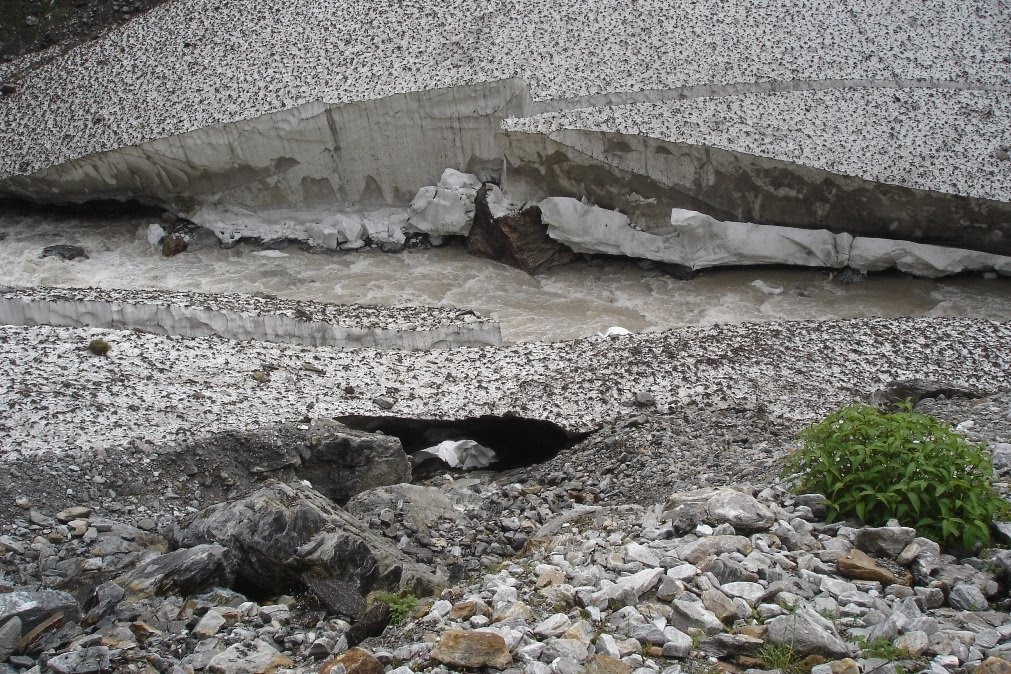
Continuing the climb, I got closer to the River Pushpavati flowing. A short descent and I crossed a bridge over the gushing waters. Then the steep ascent began. Before long, I chanced upon a remnant of a fascinating Himalayan glacier. It reminds me of a decorated cake with its icing.


It was like Waking Up to rolling green hills and billowy white clouds, flowers swaying in the fields all this seen as though in a dream. I was speechless. In the midst of such beauty, in a moment, so many moments came alive. It was a rapture of a rhapsody.Under the overhang of a large rock, we huddled to listen to our guide relate the story of Mary Legge who discovered the valley and eventually became a part of it. She slipped and died in the valley in 1939. Someone suggested that we should go and pay our respects at her memorial. 
As the guide with utmost reverence recited the words inscribed on her grave: "I will lift mine eyes unto the Hills from whence cometh my help.” There was no need to go to her memorial; she was there, everywhere. It was a lungful of life and at 13,000 feet; it felt like heaven. With Atul prancing by my side, the thought of finding pretty damsels in heaven were pushed aside. He and Amol made sure that they hung over, around and under every species of flower to get themselves photographed. 
 

It drizzled again and then followed the sun peeping through the clouds unexpectedly. Through the rest of the day the pattern continued: following sunlight, intermittent drizzle, mist, and more precipitation. The misty mountains through the sun rays gave me glimpses of the enchanting beauty around. The continuous change in the intensity of light at that height was enthralling.


At every turning, there was a new surprise. The sight of the snow clad peaks particularly made my heart leap with joy. The cascading waterfalls was a sight to behold. At certain places, the path was narrow, and slippery. I saw a few locals working at a spot where there has been a recent landslide because of rains. Nodding heads in acknowledgment, exchanging smiles and accepting a few word of advice from them to be cautious and to ensure an early return, I proceeded further.


I continued trudging the final ascent to reach the entrance to the Valley. A variety of flowers, dominated by pink and purple Balsam fill to the brim on either side of the narrow trek path. I reached the entrance and looked up, and stopped abruptly, speechless at the breathtaking sight! I heared my fellow trekker gasp and whisper, “It’s heavenly!”
Picturesque mountain landscape of rich vegetation with the ephemeral clouds wrapping the mountain tops was an amazing sight. The mountains were of different shades of green, some bare and the peaks of ones at a distance, snow-clad. Within the Valley itself there were different smaller valleys. Streams of water flew right down into the River below. There were areas of treeless green meadows which were as charming as the wooded areas.


Hundreds of species of wild flowers were everywhere and these fields in the misty mountains had a mesmerizing effect on me. No matter how carefully I walked along the narrow path, a few sadly get crushed under my feet. Wild buttercups, Himalayan Knotweeds, Gentians, Rhodiolas, wild daisies, and from what I recognized, varieties of Campanula, lilies (also cobra lilies), milk parsleys, primulas, potentillas and balsam are found aplenty. I recalled reading the Blue Himalayan Poppy and Brahm Kamal are rare species found only at these great heights.


I felt sheer joy amidst the variety of flowers in the enchanting Valley. Time flies in the resplendent fields of wildflowers. I watched the snow clad Rataban peak and the gleaming Nilgiri Parbat posing majestically in the distance.I got an urge to lie down on a small patch of grass. Initially I stretched, face upwards, and watched the sky scattered with indolent clouds. Cool breeze blows. When the sunlight gets into my eyes, I turned my face sideways and see a field of flowers: Primula, Potentillas, Geraniums, Campions, Bellflowers, Rhubarbs, Whorlflowers, Balsam, and a variety of other flowers, some quivering and others gracefully swaying in the cool breeze.


The picture of the Valley with its scenery of the mist on the trail, the sea of flowers, melting glaciers, streams with gushing waters, green meadows, snow-clad mountains and their peaks looming against the horizon is aesthetically stimulating. It permanently etched a deep impression on my mind. The beauty and serenity of the place captured me in a spell. I was completely connected with the surroundings. I feel then every bit of effort that I took to get to the top is well worth the endeavor and the weary feet.


It was now time to get back, and I remembered Ruskin Bond’s words:
…the infinity of mountains, the feeling of
space – limitless space – can only be
experienced by living in the mountains


Monday, May 17, 2010

Valley Of Flowers …. A Rare Natural Gem

On An Almost Heaven's Trek


Next morning the excitement was palpable as we all got ready for the great day. The route looked funny on the map because the road maps failed to show the mountain ranges that characterized the way from Joshimath to Govindghat. It was stunningly beautiful and we paused to capture captivating moments. The road was quite bad as we navigated slowly and crazily near the precipice due to the danger of falling rocks. Mercifully the rain held out as our convoy headed to Govindghat, 21 kms away from Joshimath. This is also the route to Badrinath.

Govind Ghat

We walked through the town of Govind Ghat.With backpacks of cameras and lenses, we made our way through the lanes of this town. I was keen to get away and start the trek. That was the moment, standing on the suspension bridge, the shiny meandering trail spanning across ridges till it was lost to the sight. It seemed so far away.

Govind Ghat
Journeying from Govindghat Ghangaria would mean an ascent of 1,220 metres (over 4,000 feet).


Suspension bridge over Alaknanda @ Govind Ghat


We crossed the river and began our trek our 13 kms to Ghangaria , the base camp for valley of Flowers as well as Hemkund Sahib.Only 30 minutes from the edge of Govindghat, I was in sparsely populated land, passing an orchard containing a gaggle of children practicing stone throwing. The first part of the trek I had read was difficult. Between swallows of breath, I stopped to capture the essence. One km away from Govindghat's main road, the zigzag mule track begins at Pulna and I noticed it has a mark of being 13 kms away from Ghangaria.


It started to drizzle and then pour.Filled with enthusiasm, I was so enamored with the beauty of the place that, save for a brief stop by at a roadside kiosk to buy a plastic raincoat, I began the trek right away. The raincoat came of use as it kept drizzling on and off during the rest of the journey. Though it was cool, the looming noon sun was beating down on us mercilessly, and made us wish we had begun the trek early that morning.I trekked relatively easily, carrying my backpack for the first two hours during which I ascended about 400 m. or so. At one point, during a steep climb, I suddenly realized that I've got to ascend more than 800 m for the day and then began to acutely feel the strain of the weight of my backpack.


Trek Route To Ghangria.

After trekking for 3-4 kms, we crossed the beautiful Bhuyundar village, a cluster of modest houses with the backdrop of misty mountains.


Bhuyundar village

For those who are not in the mood for trekking, there's a choice of hiring an animal. For that matter, there are crudely assembled palanquins available for the benefit of the faint hearted (pilgrims mostly, as I believe hikers are tough); and to carry children, also pittoos. Pittoos, porters of mostly Nepali origin, carry kids of the pilgrims in cane-woven baskets on their backs.


Those who can't make the walk, opt for mules.

The songs and the jokes were gone. Water has seeped through the socks. Spirits were still holding out but for how long? We had not even reached the half way mark. We had a light meal of maggie which was rejuvenating. March onwards, that’s what the slogan was. Mercifully the rain has eased out somewhat and the pathway is a bit more straight and manageable. Leaving the roar of the river behind, we take a turn at the mountain end as the mist lifts unveiling the magic of the valley. Negotiating through waterfalls on slippery edges, the roaring river down below seemed like an eventuality that I did not want to happen. The rain came once again and the plastic hoods were back on the heads.


We stopped often to admire the exotic flora and the many spots of cascading waterfalls from the great heights into the valley before joining the roaring waters of the flowing Lakshman Ganga. The river was flowing almost parallel to the trek path and gives me company most of the way. The long journey was a bit tiring but beautiful all the way.

River Laxman Ganga

March onwards, that’s what the slogan was. Mercifully the rain has eased out somewhat and the pathway was a bit more straight and manageable. Leaving the roar of the river behind, we took a turn at the mountain end as the mist lifts unveiling the magic of the valley. Negotiating through waterfalls on slippery edges, the roaring river down below seemed like an eventuality that I did not want to happen. The rain came once again and the plastic hoods were back on the heads.

Lines blur as the mist rolled over from all sides. The rain was unrelenting and limbs tired. Pauses were frequent and longer.Another river joined us and we walked in opposite directions. She was aggressive on her own mission. Twice,we took tea-breaks at shacks during the 7 hours trek. I watched pilgrims looking dreamy through the mist plodding along the steep trek path, wearing colorful raincoats. Both times,We chose a spot that has the River Lakshman Ganga running close to the shacks. The effect of the gurgling river has a soothing effect. The marvelous feeling of sipping tea in such surroundings was something that I can't experience even in 5-star surroundings.
Ghangaria was still miles away but we knew that we have crossed the half way mark. We crossed fellow travelers on their way back. On mules they pushed their way through, hanging precariously on the edge of the saddle. Tired as I was, still happy to be on my foot and not on an animal that has a mind of its own.