THOUSANDS OF FREE BLOGGER TEMPLATES
Showing posts with label pangong. Show all posts

Friday, May 14, 2010

Colours Of Nature At Pangong Tso

Peacock Colors In Pangong Tso


Pangong Tso is a high altitude lake in the Himalayas situated at a height of about 4,500 m. It is 134 km (83 mi) long and extends from India to China. 60% of the length of the lake lies in China. The lake is 5 km wide at its broadest point.Pangong Tso can be reached in a five-hour drive from Leh, most of it on a rough and dramatic mountain road. The road traverses the third-highest pass in the world, the Changla pass, where army sentries and a small teahouse greet visitors. Road down from Changla Pass leads through crossing river called Pagal Naala or “The Crazy Stream”. The spectacular lakeside is open during the tourist season, from May to September. An Inner Line Permit is required to visit the lake as it lies on the Sino-Indian Line of Actual Control. lake is said to change more than 15 shades during the day!


That’s Pangong Tso-a lake known for its calm, clear and unending expanse. It is the biggest lake in Asia with its area falling under both India and China. One third of it is in India and remaining in China. It is 130 km long and 7 km wide.

Pangong Tso-a lake is located on the Changtang plateau in eastern Ladakh, around 140 km South-east of Leh, at an altitude of over 14000 feet.

Pangong Tso is also known as hollow lake. It is a clear symbol of nature’s craftsmanship. Its brackish water plays with sun light to produce different colour effects.


we are now, heading north-east towards the mysterious Changla Valley and Lake, famous for the changing colors of blue waters.The road begins to climb the Col de Changla, peaking at 5360m.It runs for a little while sacred to the summit, with its sight, taste, the glass of Tea, offered by the army, and emergency sanitation facilities, where it would suddenly pulmonary edema Because of the altitude ...

 
We then descended to the Changla Valley desert to pose sand dunes in places.


Despite this, some wildlife manages to survive, a few horses grazing on semi-wild few blades of grass resistant, and very bold marmots, who forget their reserves to the military always omnipresent.
 

Finally, we reached the lake. Indescribable.


We spent the night at the inhabitant in one of the few shacks that make up the village, the last limit before the border for foreigners.The meal was an opportunity to try a Ladakhi family contact.

Hotel


Second most beautiful toilet in the world!


Friday, May 7, 2010

Ladakh-Land Of Freezing Winds And High Passes...

The Breath Taking Manali--Leh High Way

A land of freezing winds and burning hot sunlight, Ladakh is a cold desert lying in the rain shadow of the Great Himalayas and other smaller ranges. Little rain and snow reaches this dry area, where natural forces have created a fantastic landscape. Surrounded by rugged mountains this land is completely different from the green landscape of many parts of the Himalayas. Bounded by two of the world's mightiest mountain ranges, the Great Himalaya and the Karokaram, it is a land which has no match.Ladakh is one of the most beautiful hill stations, with those beautiful landscapes, green valleys, gorgeous lakes and those soothing snowy peaks. In here you breathe in the mild air and breathe out all your stress and tension.

The breath-taking view at every turn of the Manali-Leh highway imprints images that remain long after. In summer, a stream of buses and Enfield motorcycles set off from the Kullu Valley to travel along the second highest motorable road in the world, which reaches a dizzying altitude of 5,328m. It's surface varies wildly, from bumpy asphalt to dirt tracks sliced by glacial streams. This 485 km journey along different river valleys takes around 24 hours with an overnight camp at Sarchu at an altitude of 4,000 m. This highway is open only for 3 months (between July 15th and Sep 15th approx.) every year. During the other seasons of the year it is closed because of the snow.
One word makes every adventurer hold his breath in anticipation...one word makes every naturalist think of the ideal place to be...one word makes every traveler think of an exotic destination...one word makes a pilgrim think of salvation...Himalayas. Yes, the Himalayas with its rugged mountain peaks, evergreen forests, bone chilling regions, ancient temples, makes it an ideal destination for everyone: traveler, pilgrim or hardcore adventurer.

From Manali, the road crosses the Beas to begin its long ascent of the Rohtang Pass (3,900m). The views over the eternal snows of Solang Nala improve as you progress up, ranging from the coniferous forests to grassy mountain pastures. Just below the pass, the bus stops for a breakfast halt beside some dhabas. Nearby, a temple crowns the top of a bluff from where you get a great panoramic view of the upper Beas Valley.
Rohtang La (La means "Pass" in Tibetan) is the gateway to the rugged regions of Lahaul and Spiti. The pass between two 5,000-meter peaks, is one of the most treacherous passes in the region. People have been stranded there sometimes due to the sudden deterioration of weather. Rohtang literally means "pile of dead bodies".
The descent from Rohtang to the floor of the Chandra Valley affords tantalizing glimpses of the shining white sail massif. Koksar is where the road finally reaches the river. I can't forget the parathas we had there. They were aaloo-stuffed parathas, deep fried, yet not oozing oil, served with a Tibetan chutney. Finger-licking irresistible!

.


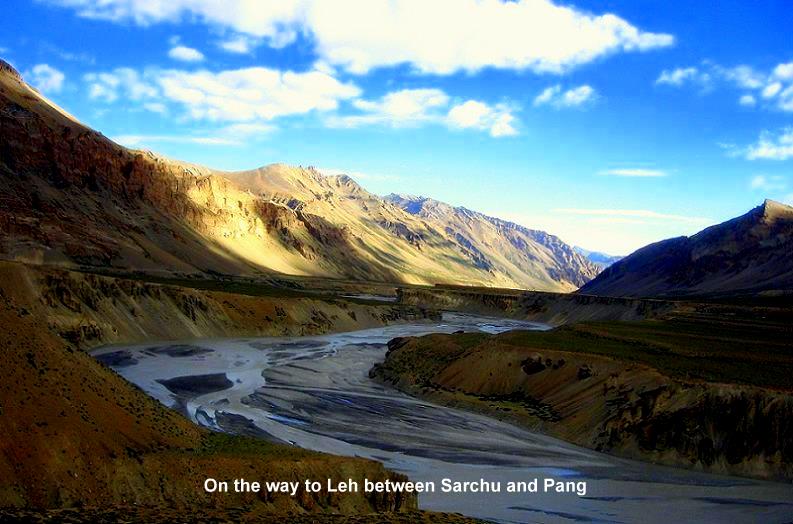
From Darcha, the road climbs steadily along the mountain side of wine-red and pale-green scree to Zingzing Bar. As you move from this desolate land, you approach Baralacha La, which will blow your mind. The "twelve-horned" pass forms the head of three valleys, the Bhaga, the Chandra, and the Yunan. By the time you get to Sarchu Serai you'll be ready for a night's rest, which is in a tent. This is in the plains next to Bagha river at the bottom of a high, straight peak. Some makeshift dhabas serve you dal-chawal for dinner.


You head to Lachlang La (5,059m) from Sarchu, the second highest pass on the highway,

before descending to Pang at 4,500m. 3 km from Pang is the extraordinary Moray Plains (4,800m), a 45-km-long plateau encircled by rolling hills and brilliant white Himalayan peaks.
The road starts its ascent from Dibring Camp to Tanglang La at a head-spinning 5,328m. This is the second highest pass in the world and by the time you reach there, your nose might well start bleeding slightly. This is a symptom of altitude-sickness. (More about this later). The Karakoram range of the Himalayas, visible from here signals that you are approaching Ladakh. This road goes along our age-old Indus (Sindhu) valley. Sindhu is the river which was the lifeline of India for thousands of years. It fed one of the oldest civilizations of the world (Indus Valley civilization). It is natural to feel overwhelmed at the sight of this great river.


The Gateway to Ladakh from Manali is Upshi. This is where the project for constructing and maintaining the highway, undertaken by the Indian army concludes. Considering the rugged terrain of the mighty Himalayas, maintaining this road itself is a Herculean task. Project Himank, as it is called, is amazing. One roadside board read, "If you want a road to the moon, please contact Himank". And we didn't find any exaggeration in it!