THOUSANDS OF FREE BLOGGER TEMPLATES
Showing posts with label zanskar. Show all posts

Friday, May 28, 2010

Leh.....Srinagar Via Khardung La......On The Roof Of The World......

Riding On The World's Most Scenic Road....


Barley field.....

The journey from Leh to Srinagar takes you from desert to lush valleys, from a Buddhist region to an Islamic one. 
Lamayuru is set in the midst of some rather strange scenery. The road through the mountains dips into a gorge that in turn opens up into moonscape badlands, with rounded, yellow pinnacles and meditation caves carved into the mountainside. Lamayuru - the oldest monastery in Ladakh, dating from the 11th century – perches quietly near the top of the mountain, overlooking the badlands. Its whitewashed walls glowed in the evening sun, which cast eerie shadows across the landscape below as we settled into our hotel for the night.


Lamayuru monastery


Lamayuru Monastery buildings

At Fotu La, the highest point of the Leh to Srinagar road....
Early the next day, about half an hour from Lamayuru, we reached the Fotu La (‘la’ means ‘pass’). At 4,100m it was the highest point of our journey. Compared with the Khardung La near Leh, the world’s highest motorable pass at 5,602m, which comes complete with souvenir shops, cafes and thousands of prayer flags, the Fotu La is pleasantly modest. There is only this sign Craig is standing next to, a few prayer flags and a satellite dish. There weren’t any other cars around either.


Fotu La


30kms short of Kargil...


The road between Leh and Srinagar used to be narrow and treacherous. Part of the army’s job is to help maintain it, as well as protect the border against militant insurgents from both Pakistan and Kashmir. Lengthy convoys of around 20 army trucks frequently passed us, in both directions. They invariably kicked up plenty of dust but their presence was vaguely reassuring.


Cattle and ther road in Nubra valley


Large-Heading out towards Kargil

33 kilometres before Islamic Kargil, Mulbekh is the last outpost of Buddhism in Jammu & Kashmir. A large relief of Buddha is carved into this jut of rock and Buddhists travel many miles to pay their respects here, but there were plenty of men wearing Muslim-style lunghis and kurtas in the village as well.


Road To Kargiil...


Flowers Everywhere,The scenery also began to take on tinge of green as our journey took us to lower altitudes and rainier climes.


The road from Leh to Srinagar cuts right through Kargil, the most important site of the 1999 Kargil War, which kicked off when Pakistani soldiers and Kashmiri freedom fighters crossed the Line of Control.
.                                                                                 Continued....

Wednesday, May 12, 2010

Ladakh-Riding Through The land Of Mountains and Deserts

Land Of Lamas

One word makes every adventurer hold his breath in anticipation...one word makes every naturalist think of the ideal place to be...one word makes every traveler think of an exotic destination...one word makes a pilgrim think of salvation...Himalayas. Yes, the Himalayas with its rugged mountain peaks, evergreen forests, bone chilling regions, ancient temples, makes it an ideal destination for everyone: traveler, pilgrim or hardcore adventurer.


This was a testing time indeed. A stretch of 96 kms to Rumtse via, Tanglang La (17,852 ft asl) with nothing in-between except the rolling mountains.


After Rumtse we moved ahead to reach Leh while visiting the Buddhist Gompas at Hemis, Thikse and Spituk. Hemis Monastery is the oldest in the Ladakh region and is a seat of Buddhist culture and religion. We wondered at the beautiful murals and the enormous statues of Buddha/ Maitreya/ Chamba and Taradevi. Thikse Gonpa is the largest in the region and is built covering a huge hillock. Spituk monastery is situated very near Leh city and dates back to 14th Century AD.
 
Ladakh is a unique region with diverse landscapes: brown sandy deserts and purple, rust cliffs amidst snow clad mountains, where summer is lush green and winter is snow white. And the people are always willing to help travellers, a smile seemingly permanently imprinted on their faces, despite the rigours of their lives.


Our onward journey was to the unexplored regions of Nubra Valley via Khardung La (18380 ft asl) the worlds highest motorable road. The road took us through the most exotic regions where we were beset with surprises throughout our odyssey. The first a stretch was of sand dunes in the middle of snow clad mountains. We had to rub our eyes and pinch ourselves to believe that there exists a desert amidst the snow peaks.


Monday, May 10, 2010

Ladakh....The Land Of Rocks,A Trekker's Paradise...

Ladakh--Trekker's Paradise

Ladakh - the land of many passes, of freezing high barren landscapes lying across the lofty Asian tableland - is among the highest of the world's inhabited plateaus. Remote yet never isolated, this trans Himalayan land is a repository of a myriad cultural and religious influences from mainland India, Tibet and Central Asia.


The first impression of Leh was that of a desert with green patches fed by the Indus. One of the first things you notice are the prayer wheels with ringing bells. As Leh is 3,505 m above sea level, most tourists experience a degree of altitude sickness. The symptoms are persistent headaches, dizziness, drowsiness, bleeding and blocked nose, and/or shortness of breath. It is because your body has not yet acclimatized to the comparative lack of oxygen. So the tourism department suggests you take complete rest for at least 48 hours.


Amidst starkly beautiful and majestic mountains, gradually merging into an oasis of green fields, Leh is situated, on the banks of the Indus, at a height of 11,000 feet. For seven months a year, Leh airport is Ladakh's only link with the outside world. Transport, tour operators, boarding and lodging facilities are available to suit every pocket and there is sufficient novelty, antiquity, hospitality and bargains to satisfy the quest of all types of visitors. With a population of 10,000 people, mainly Buddhist, some Argoos (Muslim descendants of Yarkandi traders) and a small Christian community, Leh bears the distinct stamp of its history as the administrative, commercial and cultural capital of Ladakh. A memorable sight of the Leh bazar is the group of women, traditionally attired, selling fruits, vegetables and household articles spinning and knitting, and exchanging gentle banter between themselves and with passersby.

Leh, the Ladakhi capital, sprawls from the foot of a ruined Tibetan-style palace - a maze of mud-brick and concrete. Leh only became the regional capital in the seventeenth century, when Sengge Namgyal shifted his court here from Shey, 15 km southeast, to be closer to the head of the Khardung La-Karakoram corridor into China. (Khardung La is the world's highest pass, 39 kms from Leh).

Predominantly Buddist, Leh has 25% Muslim population.These are Ladakhi Muslims, with their own cultural heritage, quite distinct from elsewhere. 
 
Ladakh is a trekkers' paradise. Foreigners move around with their backpacks, heading in different directions. Attractions in and around the town itself include the former palace and Namgyal Tsemo gompa. A short walk across the fields, the small monastery at Sankar harbours accomplished modern tantric murals and a thousand-headed Avalokitesvara deity.

Among the string of picturesque villages and gompas within reach by bus are Shey, site of a derelict seventeenth-century palace, the spectacular Tikse gompa and the Hemis gompa, the largest in the region. Tikse has a huge statue of the sitting Buddh
a.


The mosque, city palace, the bazar and the gompas are all within walking distance. Shey, Spituk and Phyang are quite close while Stok, Mashro, Thikse, Stakna, Chenlrey, Hemis, Likir, Basgo and Alchi are all a day's touring distance with regular bus and taxi services plying daily. Rumbak and Markha offer exciting treks, while Stok Kangri is the best for a climb. Boating and river running too is possible on the Indus.

Friday, May 7, 2010

Ladakh-Land Of Freezing Winds And High Passes...

The Breath Taking Manali--Leh High Way

A land of freezing winds and burning hot sunlight, Ladakh is a cold desert lying in the rain shadow of the Great Himalayas and other smaller ranges. Little rain and snow reaches this dry area, where natural forces have created a fantastic landscape. Surrounded by rugged mountains this land is completely different from the green landscape of many parts of the Himalayas. Bounded by two of the world's mightiest mountain ranges, the Great Himalaya and the Karokaram, it is a land which has no match.Ladakh is one of the most beautiful hill stations, with those beautiful landscapes, green valleys, gorgeous lakes and those soothing snowy peaks. In here you breathe in the mild air and breathe out all your stress and tension.

The breath-taking view at every turn of the Manali-Leh highway imprints images that remain long after. In summer, a stream of buses and Enfield motorcycles set off from the Kullu Valley to travel along the second highest motorable road in the world, which reaches a dizzying altitude of 5,328m. It's surface varies wildly, from bumpy asphalt to dirt tracks sliced by glacial streams. This 485 km journey along different river valleys takes around 24 hours with an overnight camp at Sarchu at an altitude of 4,000 m. This highway is open only for 3 months (between July 15th and Sep 15th approx.) every year. During the other seasons of the year it is closed because of the snow.
One word makes every adventurer hold his breath in anticipation...one word makes every naturalist think of the ideal place to be...one word makes every traveler think of an exotic destination...one word makes a pilgrim think of salvation...Himalayas. Yes, the Himalayas with its rugged mountain peaks, evergreen forests, bone chilling regions, ancient temples, makes it an ideal destination for everyone: traveler, pilgrim or hardcore adventurer.

From Manali, the road crosses the Beas to begin its long ascent of the Rohtang Pass (3,900m). The views over the eternal snows of Solang Nala improve as you progress up, ranging from the coniferous forests to grassy mountain pastures. Just below the pass, the bus stops for a breakfast halt beside some dhabas. Nearby, a temple crowns the top of a bluff from where you get a great panoramic view of the upper Beas Valley.
Rohtang La (La means "Pass" in Tibetan) is the gateway to the rugged regions of Lahaul and Spiti. The pass between two 5,000-meter peaks, is one of the most treacherous passes in the region. People have been stranded there sometimes due to the sudden deterioration of weather. Rohtang literally means "pile of dead bodies".
The descent from Rohtang to the floor of the Chandra Valley affords tantalizing glimpses of the shining white sail massif. Koksar is where the road finally reaches the river. I can't forget the parathas we had there. They were aaloo-stuffed parathas, deep fried, yet not oozing oil, served with a Tibetan chutney. Finger-licking irresistible!

.


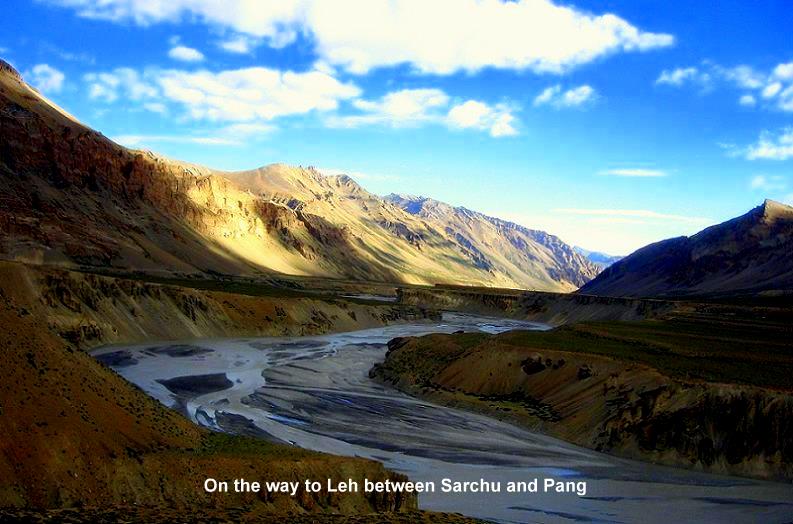
From Darcha, the road climbs steadily along the mountain side of wine-red and pale-green scree to Zingzing Bar. As you move from this desolate land, you approach Baralacha La, which will blow your mind. The "twelve-horned" pass forms the head of three valleys, the Bhaga, the Chandra, and the Yunan. By the time you get to Sarchu Serai you'll be ready for a night's rest, which is in a tent. This is in the plains next to Bagha river at the bottom of a high, straight peak. Some makeshift dhabas serve you dal-chawal for dinner.


You head to Lachlang La (5,059m) from Sarchu, the second highest pass on the highway,

before descending to Pang at 4,500m. 3 km from Pang is the extraordinary Moray Plains (4,800m), a 45-km-long plateau encircled by rolling hills and brilliant white Himalayan peaks.
The road starts its ascent from Dibring Camp to Tanglang La at a head-spinning 5,328m. This is the second highest pass in the world and by the time you reach there, your nose might well start bleeding slightly. This is a symptom of altitude-sickness. (More about this later). The Karakoram range of the Himalayas, visible from here signals that you are approaching Ladakh. This road goes along our age-old Indus (Sindhu) valley. Sindhu is the river which was the lifeline of India for thousands of years. It fed one of the oldest civilizations of the world (Indus Valley civilization). It is natural to feel overwhelmed at the sight of this great river.


The Gateway to Ladakh from Manali is Upshi. This is where the project for constructing and maintaining the highway, undertaken by the Indian army concludes. Considering the rugged terrain of the mighty Himalayas, maintaining this road itself is a Herculean task. Project Himank, as it is called, is amazing. One roadside board read, "If you want a road to the moon, please contact Himank". And we didn't find any exaggeration in it!